

Within the Dubai International Financial Centre, office fit-outs go far beyond routine construction works. They represent engineered environments where precision, performance, and infrastructure quality define the standard of the workspace. Financial institutions, legal consultancies, and multinational headquarters demand infrastructure that performs invisibly yet flawlessly, which is why leading cable tray manufacturers in UAE continue to influence the performance standards of commercial electrical systems. Within this context, underfloor trunking systems have become an essential component of high-performance office environments.
At Bonn Gulf, we approach cable management as an engineered infrastructure solution rather than a secondary installation activity. Underfloor trunking systems are not only about concealing cables. They are about ensuring electrical integrity, data reliability, regulatory compliance, and long-term adaptability under raised access flooring systems.
The Infrastructure Challenge in DIFC Offices
DIFC Grade A offices typically operate with raised access floors ranging between 150 mm and 300 mm cavity depth. These spaces accommodate structured cabling, electrical distribution, HVAC services, and occasionally fire detection loops. The complexity increases in open-plan financial trading floors where workstation density may exceed 1 desk per 6 to 8 square meters.
According to international workplace benchmarking data, modern corporate offices require approximately 3 to 5 times more data cabling than they did fifteen years ago. Power loads have also increased due to multiple monitors, conferencing systems, and hybrid collaboration infrastructure. This escalation places pressure on containment systems beneath the floor.
Without proper segregation of power and data, organizations risk electromagnetic interference, signal degradation, overheating, and non-compliance with IEC and BS standards.
Raised Floor Trunking: Technical Configuration
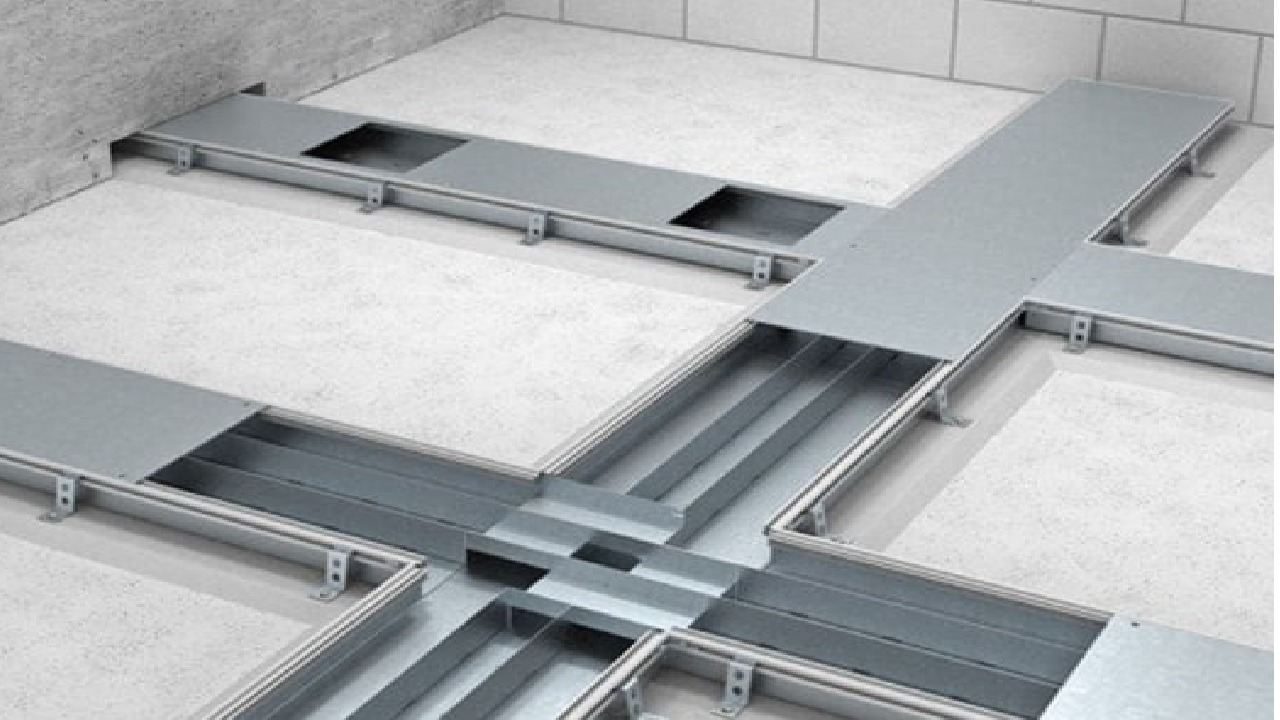
Raised or cavity floor trunking systems are widely regarded as the most flexible configuration for commercial buildings. These trunkings are laid directly on the slab beneath raised floor tiles, with service outlets flush-mounted into floor panels. The system allows relocation of outlets without structural modification, a critical advantage for evolving office layouts.
Standard Trunking Configurations
- 100 x 40 mm two-compartment systems
- 225 x 40 or 50 mm three-compartment systems
- 300 x 40, 50, or 70 mm three-compartment systems
- 450 x 40, 50, or 70 mm configurations
- Depths can extend up to 100 mm depending on load and routing requirements.
Material specifications typically follow BS EN 10142 for pre-galvanized steel or hot-dipped galvanization standards for corrosion resistance. Thickness ranges from 1.0 mm to 1.5 mm depending on span and compartment width. Why does this matter in DIFC? Because raised floors experience concentrated point loads from safes, filing systems, and mobile workstations. Structural integrity of the trunking must align with floor loading criteria.
Power and Data Separation: Engineering Logic
One of the most critical aspects of underfloor trunking design is compartmental segregation. Two- or three-compartment trunking allows dedicated channels for:
- Low-voltage data cabling
- Power circuits
- Control or auxiliary systems
Segregation reduces electromagnetic interference between power lines and sensitive CAT 6 or CAT 6A structured cabling. In high-frequency environments such as trading offices or data-heavy legal practices, signal integrity directly impacts operational reliability, particularly when integrated with vertical distribution systems such as ladder cable tray for plant room and riser coordination.
Industry standards such as IEC 61537 and BS EN 50085 require proper containment classification and mechanical performance testing. Advanced systems are designed to support structured cabling requirements and heavy loads simultaneously.
Consider a practical scenario. A DIFC office housing 150 employees may deploy over 600 data points and 300 power outlets. Without organized routing and separation, thermal buildup and cross-interference become inevitable. Structured underfloor trunking ensures predictable routing paths, simplifies fault tracing, and reduces downtime.
Flexibility and Reconfiguration
Financial institutions in DIFC frequently undergo spatial reconfiguration due to mergers, regulatory changes, or team expansions. Raised floor trunking enables outlet relocation within the same plane without breaking screed or altering slab structures.
This flexibility translates into cost efficiency. Studies in commercial fit-out management indicate that adaptable containment systems can reduce reconfiguration expenses by up to 25 percent over a five-year lease cycle.
Are we designing offices for static occupancy? Or are we building adaptive infrastructure that anticipates change? In DIFC, the latter is the only viable answer.
Compliance and Performance
Underfloor trunking systems must align with multiple performance criteria:
- Fire and life safety codes in the UAE
- IEC 61537 cable management standards
- Load-bearing requirements for raised flooring systems
- IP ratings for floor boxes
Tested systems demonstrate concentrated load resistance and compatibility with structured cabling networks.
In regulated financial districts, documentation is as important as hardware. Engineering submittals, compliance certificates, and coordinated MEP layouts must be integrated into the fit-out process from early design stages.
Integration with Floor Boxes and Service Outlets
Service outlet boxes are typically available in 250 x 250 mm or 300 x 200 mm configurations with adjustable depths between 75 mm and 85 mm. Mounting plates accommodate power modules, RJ45 data ports, HDMI, and other low-voltage interfaces.
Precision alignment between trunking runs and floor box locations determines accessibility and aesthetic integration. Poor alignment results in awkward panel cuts and compromised floor tile stability. In premium DIFC offices, such imperfections are unacceptable. At Bonn Gulf, we treat underfloor trunking as a core part of the building’s infrastructure, not just a supporting element. We analyze project requirements in detail, including power loads, data density, and space planning, to recommend systems that deliver both performance and flexibility. Our team coordinates closely with consultants and contractors to ensure proper installation, compliance, and long-term reliability. When power and data networks are planned correctly from the beginning, the office functions smoothly, safely, and efficiently for years to come.