

GRP Cable Trays for Dubai Wastewater Treatment Plants: Engineering Control in H₂S-Intensive Environments
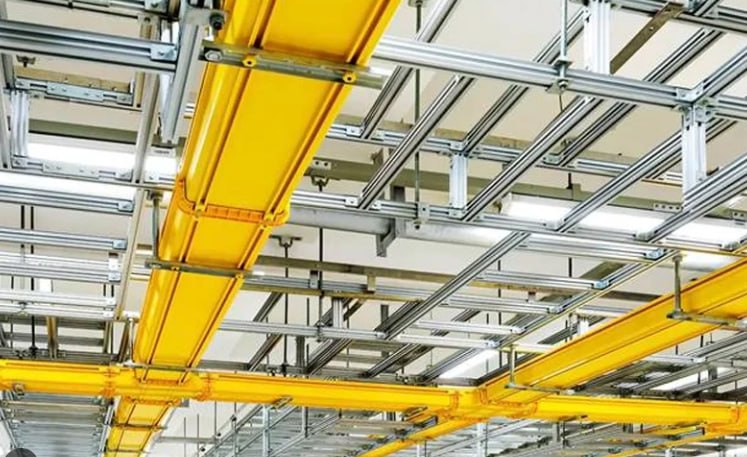
In Dubai’s wastewater treatment infrastructure, corrosion is not an abstract engineering concern. It is a daily operational reality. Hydrogen sulfide gas, constant humidity, biological byproducts, and elevated Gulf temperatures create one of the most aggressive service environments for electrical infrastructure. In these facilities, cable containment is not just structural support. It is part of the plant’s reliability system. As one of the established cable tray suppliers in Dubai, we have seen firsthand how material selection directly impacts operational continuity in these demanding environments.
From our experience supplying industrial-grade solutions across the UAE, we have seen a clear pattern. Metallic cable trays in wastewater environments begin their lifecycle strong, but exposure dictates their decline. The conversation is not about whether corrosion will occur. It is about how quickly it will compromise structural performance. This is precisely where GRP cable trays change the equation.
The Chemistry Behind The Problem
Hydrogen sulfide forms naturally during anaerobic digestion processes within wastewater treatment plants. When H₂S gas interacts with moisture and oxygen, it produces sulfuric acid. That acid aggressively attacks carbon steel and steadily undermines galvanized coatings. Even stainless steel is not immune under sustained acidic condensation.
In practical terms, this means galvanized trays installed in sludge processing zones, pumping galleries, or enclosed wet wells often show coating failure within three to five years. Once the zinc layer is breached, corrosion accelerates. Load-bearing capacity reduces. Structural reliability becomes uncertain.
Dubai’s wastewater facilities operate continuously. Electrical failures caused by corroded support systems are not minor inconveniences. They disrupt essential municipal services. That level of exposure demands a material engineered for chemical stability, not surface protection.
Why GRP Performs Differently
Glass Reinforced Plastic is not protected metal. It is a non-metallic composite engineered to resist chemical attack at a structural level. Manufactured through pultrusion, GRP profiles maintain uniform fiber distribution and consistent mechanical strength along their entire length.
The distinction matters. GRP does not rust. It does not pit. It does not require coatings to survive in hydrogen sulfide atmospheres. Its resistance is intrinsic, not applied.
For wastewater applications where grp cable trays are specified for long-term durability, this translates into measurable benefits:
- Immunity to electrochemical corrosion
- Non-conductive composition eliminating grounding requirements
- Non-magnetic structure suitable for instrumentation areas
- High strength relative to weight
- No repainting or protective maintenance cycles
GRP systems are typically 40 to 50 percent lighter than equivalent steel assemblies. Reduced weight simplifies installation and lowers support structure demand, particularly in retrofitting projects.
Lifecycle Thinking Over Short-Term Savings
Infrastructure decisions must reflect long-term performance, not procurement cost alone. Metallic trays may appear economical during installation, yet corrosion mitigation, recoating, structural inspections, and periodic replacements increase operational expenditure over time.
Across wastewater projects in the GCC region, properly specified GRP cable trays have demonstrated service lives extending 20 to 30 years in chemically aggressive zones without measurable structural degradation. When compared to metallic systems that require significant intervention within a decade, the economic rationale becomes straightforward.
In high-capacity wastewater plants, maintenance access to cable routes often requires confined space procedures and safety controls. Reducing maintenance frequency is not simply cost efficiency. It improves safety compliance and operational continuity.
Thermal Performance In Gulf Conditions
Dubai’s industrial facilities routinely experience ambient temperatures above 45°C during peak summer months. Metallic trays exposed to direct sunlight absorb and transfer heat to installed cables. Elevated cable temperatures accelerate insulation aging and may influence electrical efficiency.
GRP exhibits low thermal conductivity. It does not transmit solar heat to cables in the same way as metal. This characteristic supports cable longevity and contributes to stable performance in exposed treatment zones.
Additionally, GRP does not participate in galvanic reactions when adjacent to dissimilar materials. In humid wastewater environments where multiple alloys are present, this eliminates localized corrosion risks often observed in mixed-metal assemblies.
Fire Safety And Electrical Integrity
Wastewater treatment plants include emergency power circuits, pumping systems, and automated control networks. Cable containment systems must contribute to overall fire safety strategy. GRP trays manufactured with fire-retardant resins demonstrate controlled flame spread and self-extinguishing behavior. In enclosed service tunnels and equipment galleries, limiting flame propagation is essential.
The non-conductive nature of GRP also enhances electrical safety in moisture-heavy areas. Removing conductive pathways reduces the risk profile in environments where condensation and chemical vapors are constant.
Engineering With Accountability
Specifying cable management in wastewater facilities is not a cosmetic decision. It defines how reliably electrical infrastructure will perform over decades of chemical exposure.
In hydrogen sulfide environments, corrosion-resistant composite systems are not upgraded. They are technically appropriate solutions. Choosing metallic systems in these conditions introduces predictable deterioration. Choosing GRP removes that variable from the lifecycle equation.
If you are evaluating a new installation or upgrading an existing treatment facility, consider the operational horizon carefully. Are you designing around corrosion, or are you eliminating it? In H₂S-intensive environments, materials either endure or they degrade. GRP cable trays provide the structural stability, chemical resilience, and lifecycle performance required for Dubai’s wastewater treatment plants to operate safely and continuously for decades.